


Small-space living
When every possession claims floor space, a compact room starts to feel smaller than it is. Moving useful and meaningful objects upward returns breathing room without asking the household to live with less personality.


10% off orders of $2,000+ −$252.00 Offer terms
Photos may show styling items, such as cushions or décor, that aren't included, and a finish other than the one you select.
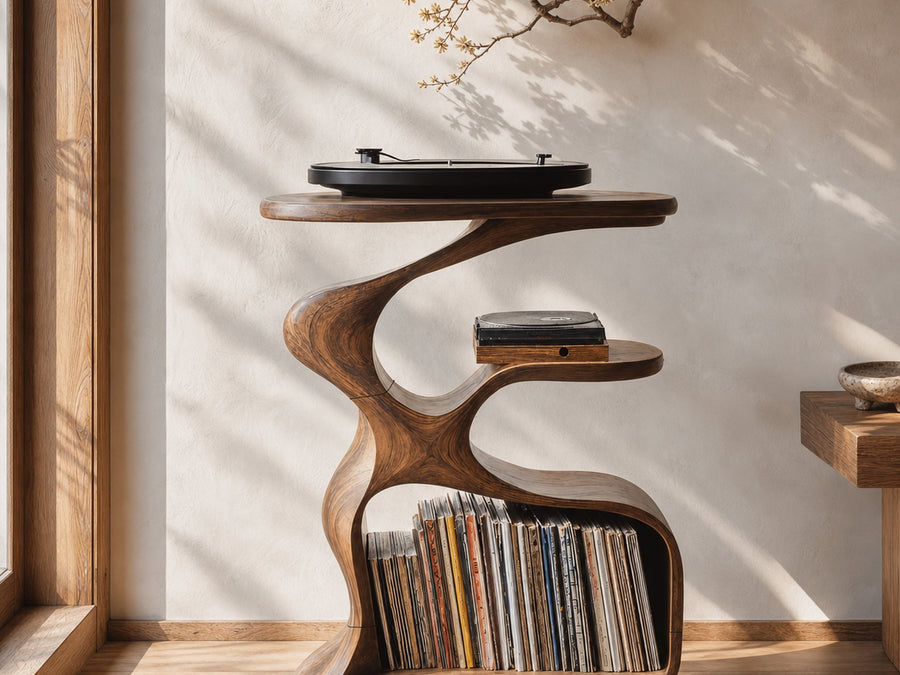
Natural grain and the individual contours of this bookshelf remain visible after its wood surfaces are refined and finished by hand.
Only the wooden bookshelf is sold.
Not included: books, bottles, electronics, baskets, and displayed collections; other non-wood accessories; decorative objects and styling props.
Wood grain, knots, edge contours, and color naturally vary from piece to piece. Product images show the expected character rather than an identical grain pattern.
These products are not waterproof. Their durable wood-and-finish construction is designed to handle ordinary accidental spills when liquid is wiped up promptly. Avoid standing water, soaking, submersion, and harsh cleaners.
SKU: TIM-00858-001
Built for your order: about 4 weeks from payment, then 4–7 business days in delivery.
We keep you updated at every step — Order confirmation and a detail check first, then build updates and photos from the workshop, then tracking and a scheduled delivery window.
We send photos of your finished piece before it ships.
Crated and tracked — Every piece ships crated or blanket-wrapped, with tracking or a scheduled freight window.
Every piece is built to order — send us your target size and we confirm feasibility and price before you pay. Custom dimensions on request
Exact dimensions for each size are listed on the option you select above. Most pieces arrive fully assembled; wall-mounted designs include hardware and a template. Measure doorways and stair turns before ordering — most pieces pass a standard 32-inch doorway.
Care: wipe with a soft, dry cloth and oil the grain once or twice a year to keep the surface nourished.
Free standard shipping to the 48 contiguous U.S. states. Your piece ships crated or blanket-wrapped; freight delivery is curbside, with a scheduled window and tracking. For Alaska, Hawaii, U.S. territories and international orders, contact us first for a quote.
Damaged, defective, incorrect or not-as-described items: request a return or exchange within 30 days of receiving your order. Contact us before returning anything; we arrange approved return freight and help with repacking. We repair, replace or refund these pieces at no cost, custom sizes included. Change-of-mind returns are not accepted. You can cancel free of charge within 48 hours of payment, before your wood is cut.
Still deciding

 Bookshelves
Modern Tree Bookshelf For Living Room
From $4,480.00
Bookshelves
Modern Tree Bookshelf For Living Room
From $4,480.00

 Bookshelves
Contemporary Wooden Wall Mounted Bookshelf For Living Room
From $1,680.00
Bookshelves
Contemporary Wooden Wall Mounted Bookshelf For Living Room
From $1,680.00

 Bookshelves
Organic Sculptural Wooden Bookcase For Modern Home
From $2,240.00
Bookshelves
Organic Sculptural Wooden Bookcase For Modern Home
From $2,240.00

 Bookshelves
Farmhouse Decorative Bookcase Display Organizer For Living Room
From $2,980.00
Bookshelves
Farmhouse Decorative Bookcase Display Organizer For Living Room
From $2,980.00
Bookshelf for small-space living
Run your hand along the top and you can feel the work: a plank pulled from the stack by experienced selectors, kiln-dried until the moisture settles, then planed and finished by one maker in our workshop. It's solid wood all the way through, without a sheet of veneer or particleboard anywhere in it.

In the room
When every possession claims floor space, a compact room starts to feel smaller than it is. Moving useful and meaningful objects upward returns breathing room without asking the household to live with less personality.
Natural wood, workshop shaping, and a finish selected for everyday use give the piece a durable foundation for real routines. Care still matters, but the design is intended to remain part of the room rather than feel temporary.
Any of these can be built to your own measurements — width, height or depth.
Material

Real grain, real figure: every board here grew for decades before it reached the bench, and no two carry the same pattern.

Finished by hand with oil that sinks into the wood instead of sitting on top, so small marks blend in and the surface can always be renewed.

Solid stock with real heft. Dried before the build, it sits flat and stays put.

Natural wood settles into its own tone with time and light. Scratches sand out, and a tired finish comes back with fresh oil.
The grain that arrives is yours alone.
Where you left off
Join the workshop letter and take 5% off your first order.
Something went wrong — please try again.
One-of-one pieces, once-a-month letters. Unsubscribe anytime.
Here's 5% off your first order:
WELCOME5
Applied automatically at checkout.