The doorbell is half an hour out, and you're making the pass every host knows: three remotes into a drawer, the mail stack out of sight, the kids' library books into a pile that has nowhere to go. The room is clean now, but it still feels full — and you find yourself looking at the one wall that could fix this, if only what hung there did not look like more furniture. This is the storage problem in most living rooms. It isn't a shortage of places to put things. It's that the places themselves take up the room.
Why storage feels heavy
A room reads as spacious when two things are visible: floor and wall. Most storage eats both. A tall bookcase claims a wall from baseboard to ceiling; a deep media cabinet pushes its shadow a foot and a half into the room. The eye tallies all of it, and the space feels smaller than the tape measure says.
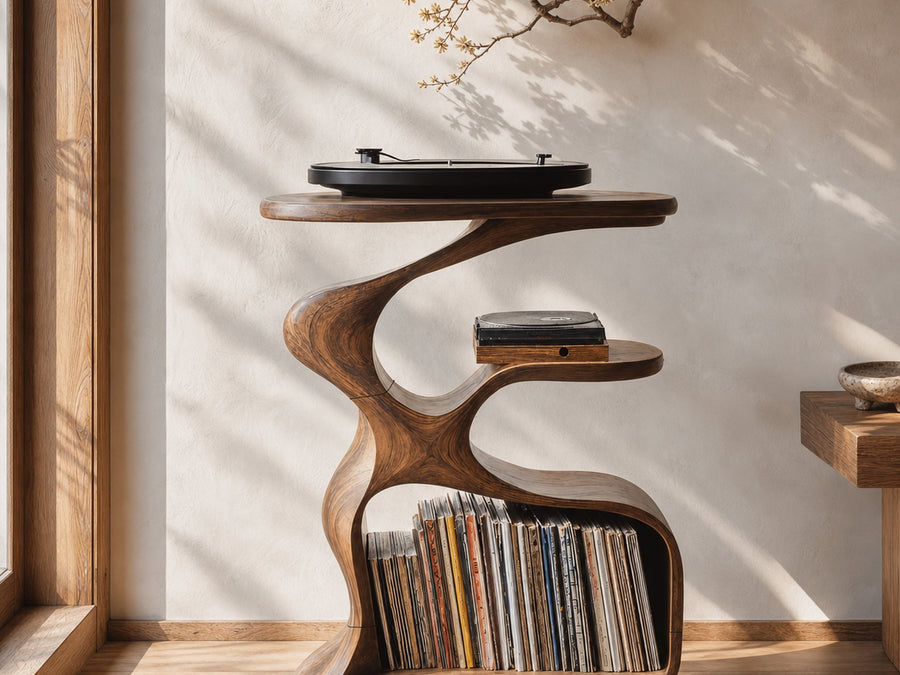
Sculptural storage takes the opposite bet. Hold less, hold it beautifully, and let the piece itself be worth looking at, so the wall does work without disappearing behind boxes.
Off the floor: the case for floating shelves
A floating shelf is the lightest storage there is, visually. It puts nothing on the floor and nothing casts a shadow under it; what the eye gets is a clean line of wood with the wall showing above and below. Because the floor beneath stays visible, the room keeps its full footprint even while the shelf carries a row of novels and the framed photo from the lake.
Solid hardwood earns its place here in a way most shelf materials cannot. Straight, even grain lets a long shelf read as one confident line rather than a busy stripe, and a dense board carries real books without complaint, whether the shelf is teak, walnut or oak. Each shelf we build starts as a board chosen by hand for its figure, shaped, then sanded until the front edge feels finished to an open palm, because a floating shelf gets touched every time it gets used.
Two plain notes before you order. A solid wood shelf weighs real pounds loaded — it wants its anchors in studs, not drywall alone, and the hardware included assumes you will find them. And a floating shelf holds less than a bookcase on purpose: one row, chosen. If the goal is to warehouse every paperback you own, this is the wrong tool. If the goal is a calmer wall, it is the right one. At 8:58 on a Monday morning the laptop opens and the shelf behind you reads quiet on camera, one line of wood and a few spines, the same shelf that held the dinner candles the night before.
The bathroom shelf, with its evidence
A shelf over the towels is where the species matters most, and it is why so much bath furniture is built in teak: its dense, naturally oily grain is slow to take up moisture, so water tends to sit at the surface and dry off rather than soak in. Whatever the wood, the finish and your habits do the rest. One straight answer about the black spots that scare people off bath wood: that is mildew feeding on soap residue sitting on the surface, not the wood failing. Wipe standing water up, run the fan, and a well-finished shelf in a daily-shower bathroom stays clean for years.
A spacing note worth stealing: hang one long shelf rather than three short ones. A single 48-inch line calms a wall; a constellation of small shelves does the opposite.
Low, long, and grounded: the cabinet that opens a room
When you need doors — for the board games, the cords, the things that will never be display-worthy — go low and long instead of tall and deep. A cabinet that stops around 30 inches keeps every sightline in the room open, and its top becomes the surface you actually wanted: a lamp, a stack of art books, the bowl where keys land. In a room without walls, that low line does one more job. Set it behind the sofa or along the room's invisible seam and it draws the boundary the floor plan never did: living room ends here, and the eye agrees.
Solid wood matters more in a cabinet than almost anywhere else. A humid August is a cycling machine, the AC drying the air and the off hours swinging it back, and that repetition is what bubbles veneer off particleboard and racks cheap doors out of square until one never quite closes again. A solid board has no veneer to bubble, and ours has already done its moving: every board is picked by experienced selectors, then dried slowly in the kiln before the first cut, so the doors that align on delivery day still align when the seasons swing. Wood-to-wood joinery holds for decades, and an oiled solid-wood top refreshes with a light sanding whenever life has left its marks. One more consequence of building it as one piece: it arrives as one piece. Doors hung, hinges set, nothing to build. Nobody loses a Saturday between the truck and the first movie night, and there is no leftover screw to wonder about.
December is the cabinet's other annual exam. From the twelfth through the twenty-sixth the top does bar duty: the punch bowl, the sweating bottles, the tray of glasses that never quite makes it back to the kitchen. The condensation rings wipe off the oiled wood with the crumbs, as long as nobody lets them sit overnight. A film-finished top keeps that kind of month as evidence; an oiled one lets the host finally exhale.
Friday movie night is the proof. The TV floats over a clean wall while the router, the power strip, and every cable live behind the wood panel; the remotes have a drawer of their own. Warm wood where a black plastic wall of electronics used to be, and nothing left to shove out of sight when the doorbell rings.
Let the grain do the decorating
The trick of sculptural storage is that it removes the need for much else. When the shelf itself has a shaped edge and honest grain, the wall needs less art. When the cabinet front is a run of matched boards, the room needs fewer objects on top of it. One well-made piece, some deliberate empty space around it, and the twenty-minute scramble before guests gets shorter — because the room was never really cluttered, just under-shelved.
Expect your board to differ from the one photographed. No two boards carry the same figure, so the line of grain on the shelf that arrives exists nowhere else. Indoors the color settles over the first months, teak and oak toward honey-amber, walnut toward a softer brown; none of it goes patio-gray, which takes rain and open sky.
Renters, this logic works hardest for you. The landlord-beige walls change every lease; the wood does not. A low cabinet or a pair of shelves is the one piece of the apartment you actually own, and it makes the fourth address in six years feel like yours within an hour of the truck leaving.
Every piece is made to order and hand-finished, about four weeks of production from payment, then four to seven business days in delivery, with free shipping across the 48 contiguous states and 30 days from delivery to report anything damaged, defective or incorrect. If a wall in your house needs an odd length, write to support@timbervintique.com; cutting to your dimensions is what made-to-order is for.
Start with the wall that bothers you most and browse our solid wood floating shelves.