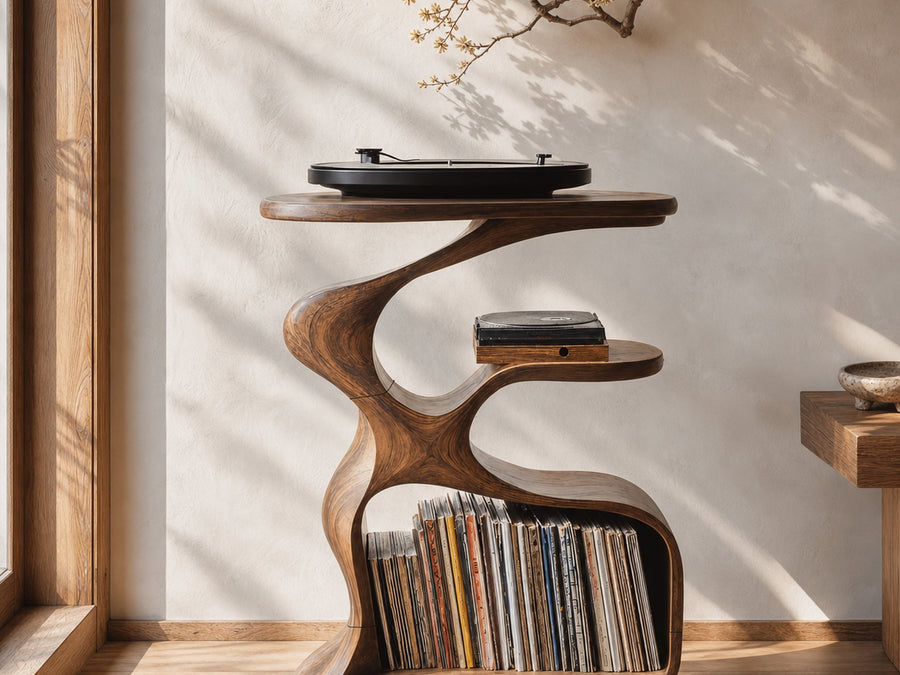
You notice it about twenty minutes into the dinner party, somewhere between the second pour and the salad. The apartment is not large. Nothing in it is loud. And yet the room keeps pulling your attention in small, pleasant increments — the way the light sits on the table, the weight of the chair under you when you lean back, the shadow line where the tabletop overhangs its base. At some point your hand finds the chair's back rail and stays there, following an edge that was clearly shaped by someone who cared how it would feel. There is no logo anywhere to explain any of this. You end up asking your host the question that unbranded quality always eventually earns: where did you find this.
Rooms that never raise their voice
Every home makes an argument, and most of us have visited both kinds. There are rooms furnished as announcements — recognizable pieces deployed like credentials, each one saying its own name slightly too loudly. And there are rooms that seem to have no interest in impressing you at all, which is exactly why they do. In those rooms nothing declares its price, but everything survives a second look: surfaces that turn out to be real material when your hand lands on them, proportions that feel resolved from every chair in the room, objects that plainly earned their place one at a time. The first kind of room is read in a glance. The second kind keeps unfolding all evening.
The difference is not budget. Plenty of expensive rooms shout, and some of the most settled rooms you will ever stand in were assembled patiently on modest money. The difference is where the signal lives. In one room it lives in the label. In the other it lives in the material, and material doesn't need your guests to have done any homework.
Material and proportion do the talking
Real material carries information the way a voice carries tone. Solid wood announces itself in ways too small to itemize and impossible to fake at close range: figure that never repeats, because it grew rather than printed; an edge that is the same wood as the face, not a wrapped skin; weight that plants a chair on the floor; the faint grip of an oiled surface under the fingertips where a laminate is uniformly slick. Nobody consciously inventories these things at a dinner party. Everybody registers them.
Proportion is the other half of the language, and it is the harder half, which is why it convinces. A tabletop's thickness in true relation to its length. A leg that tapers just enough to look alert instead of heavy. The reveal where a drawer front meets its frame, even and tight the whole way across. These decisions get made slowly, in a workshop, by people looking at the actual object — and they read from across a room the way good tailoring reads from across a street, without a single visible name attached. That is a kind of proof no logo can print.
The collected home
The rooms that hold you were almost never bought; they accrued. The rug took two years of looking. The lamp came from a flea market three moves ago and has outlasted two sofas. The armchair was reupholstered instead of replaced because the frame deserved it. Into company like that, furniture chosen for its label rarely settles. It keeps performing, and performance gets tiring at close quarters. What settles is material. A solid wood table with real figure in its surface sits as comfortably beside the flea-market lamp as beside anything from a gallery floor, because it belongs to the same category they do: things that are exactly what they appear to be.
This is also why collected rooms mix eras so easily. Walnut doesn't care what decade the rug is from. Oak has no opinion about your ceramics. Honest materials agree with each other across a century, which frees you from ever furnishing a room in one weekend to one theme — the approach that produces rooms with nothing to say.
Where to begin
Not with a full room. Quiet rooms are built one deliberate piece at a time, and the piece to start with is the one your hands touch every day — the table where the household actually happens, the chair someone sits in every evening. Choose it by the criteria that hold up at arm's length: what it is made of, how it is joined, how its proportions sit in your actual room. Each of our pieces is made to order in solid wood and finished by hand, and the surface never carries a name. The grain is the signature, and no two are alike.
Start where an evening actually rests: our solid wood chairs.