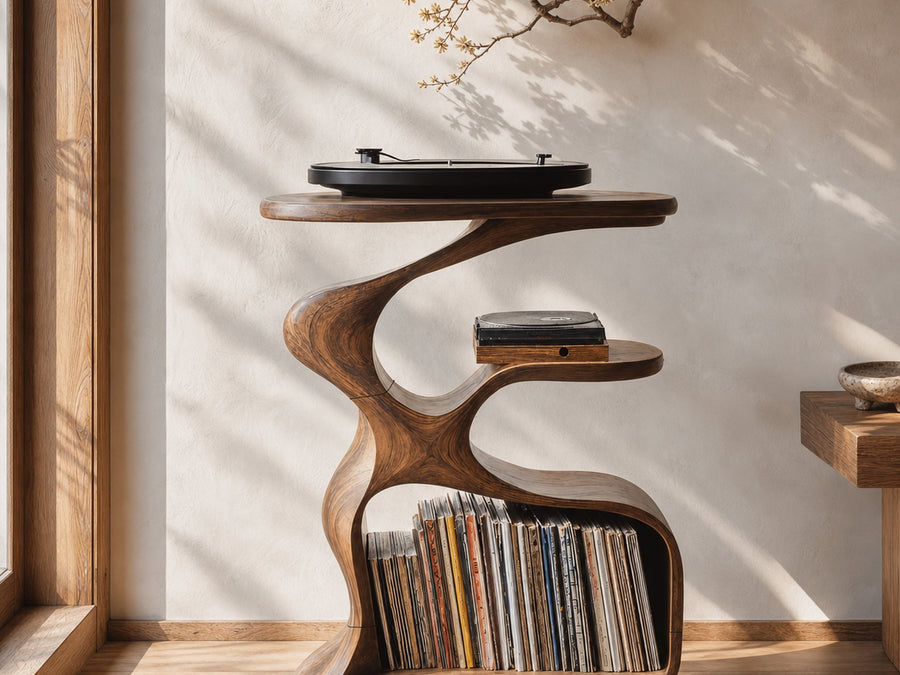
The table has been in the house a week when the light finally catches it properly, a low morning sun coming in flat across the top while the coffee brews, and you see it for the first time: arches stacked inside arches, running the length of the surface like weather on a map. You put a finger on one and follow it. It travels the whole board and slips off the end. You have owned wooden things all your life, but this is the first one you have actually read. It won't be the last, because once you can see grain, you can't stop seeing it. Choosing furniture becomes a different, better game.
Grain and figure are two different things
Woodworkers use two words where the rest of us use one. Grain is direction — the way the tree's fibers ran, the lines your hand can feel when you stroke a surface one way and then the other. Figure is the picture: the pattern that appears on the face of a board when a log is opened. Grain decides how a board behaves under a plane and a chisel. Figure decides what you will be looking at over breakfast every morning from now on. Both were set long before the sawmill, by how the tree grew, how it leaned into wind, where it put its branches. The saw only reveals them.
That cut is the single biggest reason two boards from the same tree can look like strangers.
Cathedrals, straight lines, and fleck
Saw a log through and through, like slicing a loaf, and most boards come off the flat of the growth rings. On the face of those boards the rings appear as nested arches — the pattern the trade calls cathedrals, for the obvious reason. Cathedral figure is bold, warm, and directional. It points, and it gives a big tabletop a current running through it, so that your eye rides it the way it rides a river.
Cut the same log toward the center instead, so the rings meet the face on edge, and the arches disappear into tight, straight, disciplined lines. This is quartered figure — calmer, more formal, the pinstripe suit to the cathedral's open collar. In oak it comes with a bonus: the tree's rays, which run outward from the center like spokes, get sliced along their length and show up as shimmering flecks and ribbons across the straight grain. That fleck is how you recognize quartersawn oak from across a room, and it is a large part of why the wood has furnished libraries for a century and a half.
Species add their own vocabulary on top of the cut. Walnut ranges from pale amber sapwood to a deep chocolate heart, sometimes in the same board, with a figure that can swirl like smoke where the grain turned. Oak stays graphic and legible, its open pores giving every line a drawn quality. Teak runs long and straight, gold on gold, with a low sheen that comes from the wood's own natural oils. None of these is the better answer. They are registers, and reading them is how you find the one that matches the room you are actually furnishing.
Knots, streaks, and other signatures
Now the features that make shoppers hesitate, mostly because nobody explains them. A knot is the cross-section of a branch — the exact point where the tree decided to reach for light. A sound, tight knot, surrounded by grain that flows around it like water around a stone, is structure and biography at once; the swirl it makes is some of the liveliest figure a board can offer. Mineral streaks, those olive or graphite lines that follow the grain, are the record of what the tree drank. Small pin knots, a stripe of lighter sapwood at one edge, a ripple where the grain compressed: all of it is the file the tree kept on itself.
Mass production sorts these features out, because pattern-matched uniformity is what a thousand identical units require. A workshop making one piece at a time gets to make the opposite choice: put the knot where it belongs, balance the streak, let the board keep its handwriting. Uniformity is a factory value. It is worth asking, at least once, whether it is one of yours.
Reading the board you are about to own
All of this has a practical point, and the point is that no two boards match, which means no two finished pieces match, including yours. The piece in our photographs and the piece that arrives at your door are siblings, not twins: same species, same design, same hands, different tree. The cathedrals will crest in different places. The color will sit a shade warmer or cooler until the light moves. On delivery day, read it the way you read that table in the morning sun — this figure exists exactly once, and it answers to you.
And because every piece is made to order anyway, the reading can start before the making. If you want a size the listing does not offer, a different wood for a design you love, a top calmer or livelier in figure than the photos show, write to us and say so. The workshop, which includes artisans with 30 years of hands-on woodworking experience, will confirm what is feasible, quote the price, and give you the lead time before you commit to anything. From payment, plan on about four weeks of production, then four to seven business days in delivery, with updates along the way — including, for many pieces, a photo from the bench while your boards still smell of the saw.
When you are ready to choose a board of your own, tell us what room it is for: our customization services start with a conversation.